
Garage Door Opener Motor Humming But Door Won't Move? Here's the Fix
You press the button. You hear the opener motor activate — there's a definite hum, buzz, or whir from the unit mounted to the ceiling. The motor is clearly getting power and clearly trying to do something. But the door doesn't budge. Not an inch. Or maybe the motor strains audibly for a few seconds — working harder than it normally sounds — and then shuts off with a click, leaving you staring at a garage door that absolutely refuses to cooperate.
This is one of the most disorienting opener symptoms a homeowner can encounter, because the motor sounds like it's working and yet the result is nothing. The disconnect between what your ears tell you (the opener is running) and what your eyes tell you (the door isn't moving) creates confusion about where the problem actually is — and more importantly, about whether it's something you can address yourself or something that needs professional attention.
If this is happening to you right now in San Jose, Saratoga, Campbell, or anywhere in Silicon Valley, here are the five most likely causes — listed in order from most common to least common — along with what you'll see and hear for each one, and what to do about it.
Cause 1 — The Trolley Is Disengaged (Emergency Release Was Pulled)
Start here, because this is the simplest explanation and it's more common than you'd think.
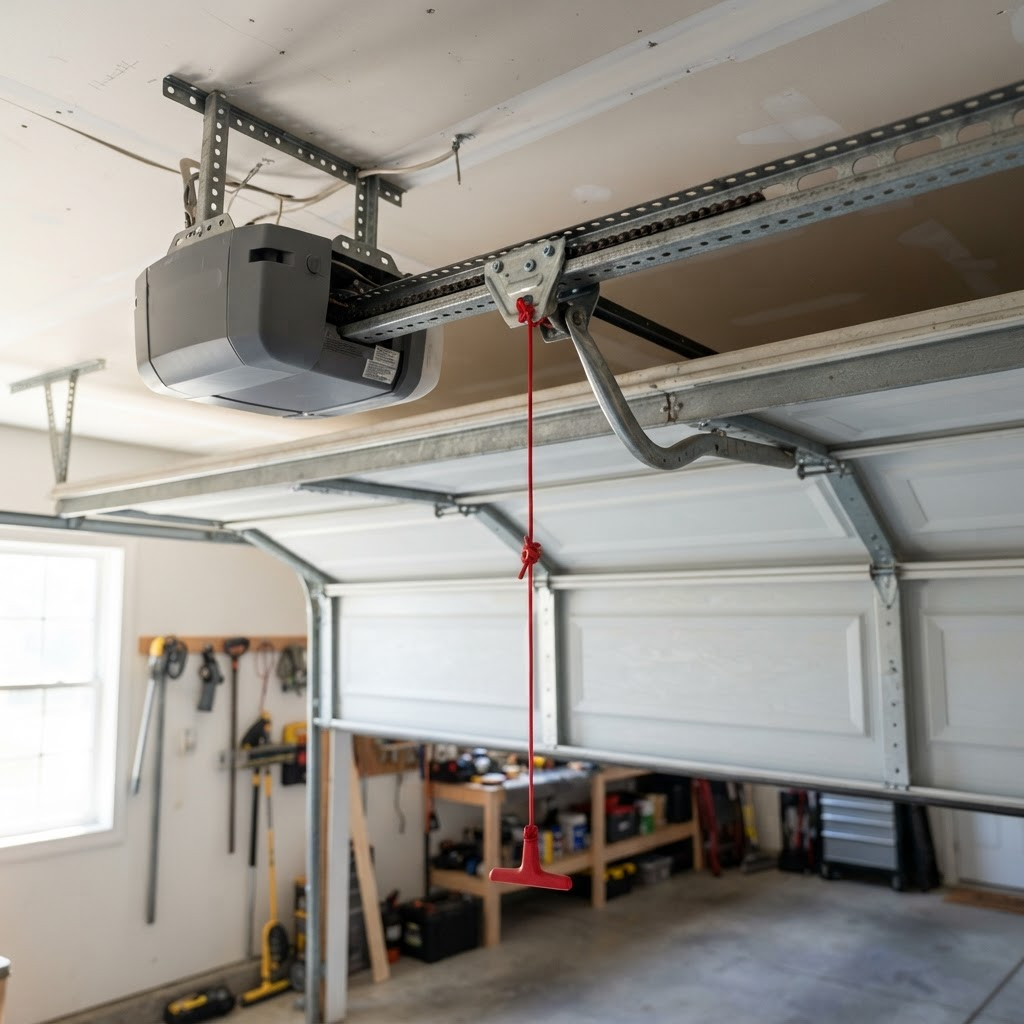
Every garage door opener has an emergency release mechanism — a red cord with a handle that hangs from the trolley on the rail. When you pull this cord, it disconnects the trolley from the drive chain or belt, allowing you to open and close the door manually. This feature exists so you can operate the door during power outages or when the opener fails.
The problem arises when the emergency release gets pulled unintentionally — a family member tugged it out of curiosity, someone brushed against it while loading items into the garage, or it was pulled during a previous power outage and never re-engaged. When the trolley is disengaged, the motor runs normally, the chain or belt moves, but the trolley just sits there — disconnected from the drive mechanism and unable to transfer the motor's power to the door.
What you'll see: Look at the rail running from the motor to the door. The trolley — the small carriage on the rail that connects to the door via a curved metal arm — should be locked into the drive chain or belt. If it's in the released position, it will be loose on the rail and you can slide it freely by hand. The emergency release cord will likely be hanging in the pulled-down position rather than tucked up against the rail.
The fix: Pull the release cord back toward the motor unit until the lever clicks back into the engaged position. Then press your wall button or remote. The motor will drive the chain or belt, the trolley will catch and lock into the drive mechanism, and the door should respond normally.
Cause 2 — Stripped Gear Inside the Opener
This is the most frequent cause of the "motor hums but door doesn't move" symptom when the trolley is properly engaged. It's a mechanical failure inside the opener that requires repair but is entirely fixable.
Inside your opener's motor housing, a system of gears converts the high-speed, low-torque output of the electric motor into the lower-speed, higher-torque rotation needed to drive the chain, belt, or screw. In most residential openers, the primary drive gear is made of nylon or a similar engineering polymer — intentionally softer than the metal worm gear it meshes with. This isn't a manufacturing shortcut; it's a deliberate engineering choice. The nylon gear is designed to be the sacrificial component in the system — when excessive force is applied (from a jammed door, an out-of-balance spring, or simple age), the nylon gear strips rather than the metal components failing or the motor burning out.
When the nylon gear strips, the motor spins the worm gear, but the worm gear's teeth have nothing to grab onto — the nylon gear's teeth have been worn smooth, chipped off, or ground down. You hear the motor running because it is running. The chain, belt, or screw doesn't move because the rotational energy never reaches it. The nylon is a classic engineering plastic chosen specifically to fail predictably and protect the costlier metal parts.
What you'll see and hear: The motor runs with its normal sound — maybe slightly higher-pitched than usual because it's spinning freely without load. You may see the chain or belt sitting perfectly still despite the motor running. If you look at the top of the opener, you might notice a fine white, yellow, or cream-colored powder — this is nylon dust from the stripped gear teeth, and it's a confirming visual indicator.
The fix: Gear replacement is a standard repair that most garage door technicians perform routinely. The technician opens the motor housing, removes the damaged gear assembly, installs a replacement gear kit (which typically includes the primary gear, the worm gear, and associated bearings and bushings), and reassembles the unit. The repair usually takes about an hour, and the cost in San Jose and Silicon Valley typically runs $150 to $250 including parts and labor.
The repair is worthwhile if the rest of the opener — motor, logic board, safety features, and drive mechanism — is in good condition and the unit is less than 12 to 15 years old. If the opener is older, has other developing issues, or lacks modern safety features, replacing the entire unit may make more sense than repairing a single component in an aging system.
Cause 3 — Broken Spring Making the Door Too Heavy for the Opener
This is the cause that homeowners most often miss, because they're focused on the opener (which is making the noise) rather than the door (which is the actual problem).
Your opener's motor is designed to lift roughly 10 to 15 pounds of net force. That's it. The full weight of the door — 150 to 300 pounds for a standard residential door — is counterbalanced by the springs. When the springs are working correctly, they carry almost all of the door's weight, and the opener just provides the relatively small push needed to overcome friction and get the door moving.
When a spring breaks, the counterbalance disappears. The opener's motor, expecting to push against 10 to 15 pounds of resistance, suddenly faces 200 or more pounds. It doesn't have the power to lift that weight. You'll hear the motor strain — it will run louder and harder than normal, possibly vibrating the housing visibly — and then either stall completely or trip its internal thermal protection and shut off.
What you'll see and hear: The motor sounds labored — louder than normal, with a grinding or straining quality. The door may lift an inch or two before the motor gives up. If you look at the torsion spring above the door opening, you may see a visible gap in the coils — a clear sign of a break. You may have heard a loud bang earlier — like a gunshot or firecracker — which is the sound a torsion spring makes when it snaps under tension.
What to do: Do not continue pressing the button. Every time the motor strains against a full-weight door, it damages the opener's gears, motor, and drive components. The spring is the root cause and must be replaced first. Once the springs are functioning and the door is properly counterbalanced again, the opener will resume normal operation — assuming it wasn't damaged by repeated attempts to lift the unbalanced door. Our guide on what to do when your garage door won't open covers the full diagnostic sequence starting from this symptom, including how to safely determine whether the spring has broken and what to do while waiting for professional service.
Cause 4 — Motor Capacitor Has Failed
The capacitor is a small cylindrical component inside the motor housing that stores and releases electrical energy to give the motor its initial starting torque — the burst of power needed to begin rotating from a standstill. Think of it as the motor's starting gun.
When a capacitor fails, the motor receives power (you hear the hum) but can't generate enough rotational force to begin spinning. The motor sits there buzzing or humming without actually turning. In some cases, a failing capacitor allows the motor to start intermittently — sometimes it catches and runs, other times it just buzzes.
What you'll hear: A constant, steady hum or buzz without any mechanical movement — no chain rattling, no belt whirring, no screw turning. The sound may continue for a few seconds before the motor's thermal protector shuts it off.
The fix: Capacitor replacement is one of the simpler opener repairs — typically $100 to $175 including the part and labor. A technician can diagnose a failed capacitor in minutes using a multimeter and have the replacement installed in under an hour. This is a very worthwhile repair on an otherwise healthy opener.
Cause 5 — The Door Is Physically Locked or Obstructed
Sometimes the simplest explanation is the right one, and this one is purely mechanical.
Many garage doors have a manual slide lock on the inside — a horizontal bar that extends from the door into the track to physically prevent the door from being opened. If this lock is engaged while someone tries to operate the door with the opener, the motor strains against the locked mechanism without being able to move the door.
What you'll hear: The motor straining and then stopping — similar to the broken spring scenario, but without the loud bang or visible spring damage. Check the inside of the door for a horizontal bar or lever that slides into the track. If it's extended, slide it back to unlock the door.
Similarly, check for external obstructions — anything wedged against the outside of the door, ice or debris at the threshold (rare in Silicon Valley but possible), or a vehicle parked too close to the door.
What to Do Right Now — Priority Checklist
If your opener motor is humming right now and the door isn't moving, work through this sequence:
- Check the emergency release. Is the trolley engaged? If not, re-engage it and test.
- Check the manual lock. Is the slide bar extended into the track? If so, retract it and test.
- Look at the springs above the door. Do you see a gap, a break, or separated coils? If yes, stop operating the door — you need professional spring replacement.
- Listen to the motor carefully. Is it straining under load (suggesting a door weight problem) or running freely without resistance (suggesting a stripped gear)?
- Look for nylon dust on or beneath the opener housing. Its presence confirms a stripped gear.
If the issue is a disengaged trolley or a locked slide bar, you've solved it. If the issue is a broken spring, stripped gear, or failed capacitor, call for professional garage door repair. Our technicians carry gear kits, capacitors, springs, and complete opener replacement units on every truck, so most repairs are completed in a single visit regardless of which cause we find.
Our comprehensive garage door opener troubleshooting guide covers the full range of opener symptoms and diagnostics beyond the motor-humming scenario covered here — including situations where the motor doesn't activate at all, where the remote works intermittently, and where the opener runs but the door reverses.
Whether you're in Willow Glen, Milpitas, Los Altos, Fremont, or anywhere across Silicon Valley, we'll diagnose the issue quickly and give you a clear, honest answer — repair or replace — with transparent pricing before any work begins. A humming motor with a motionless door is frustrating, but in most cases, the fix is faster and more affordable than you'd expect.
Motor humming but the door won't move? Get same-day opener repair.
Our trucks carry gear kits, capacitors, springs, and replacement openers, so we diagnose and fix most humming-motor problems in a single visit — with transparent pricing before any work begins.
Request same-day opener repair