
Garage Door Sensor Blinking? How to Fix Safety Sensor Problems
Your garage door opens without any issues. But when you try to close it, the door starts moving down, then immediately reverses and goes back up. The opener light blinks several times. You try again — same result. The door refuses to close, and the blinking pattern tells you the opener knows something is wrong even if you can't see what it is.
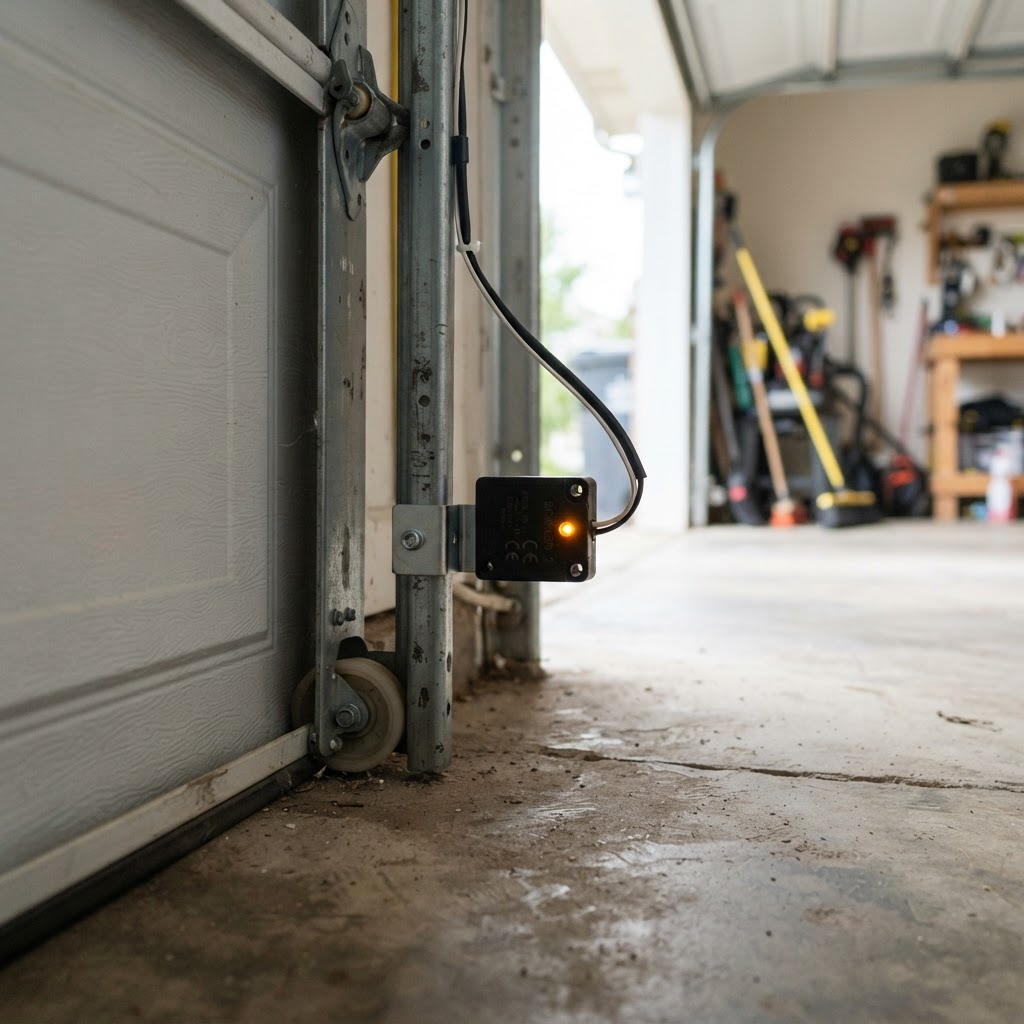
In the vast majority of cases, this behavior points to one thing: your safety sensors — the two small devices mounted near the bottom of the door tracks on either side of the opening — are misaligned, obstructed, dirty, or have a wiring problem.
Safety sensors are one of the most common sources of service calls we receive from homeowners across San Jose and Silicon Valley, and the good news is that many sensor issues can be diagnosed and resolved without a service call. This guide walks you through every possible cause and fix.
How Safety Sensors Work
Since 1993, all garage door openers sold in the United States have been required by federal safety regulations under UL 325 to include an auto-reverse mechanism with photoelectric sensors. These sensors create an invisible infrared beam across the bottom of the door opening. One sensor — the sending unit — emits the beam. The other sensor — the receiving unit — detects it.
When the beam is unbroken, the opener knows the doorway is clear and allows the door to close. When anything interrupts the beam — a person, a pet, a bicycle, a box — the opener immediately stops the door or reverses it to prevent the door from closing on whatever is in the way.
This system has prevented countless injuries and fatalities since its introduction, and it's a feature you never want to bypass or disable, no matter how frustrating a sensor problem might be.
Identifying the Problem — Read the Lights
The sensor lights are your primary diagnostic tool. Walk to the bottom of each door track and look at the sensor units. Here's what the lights tell you.
On most brands — including LiftMaster, Chamberlain, and Genie — the sending sensor has a steady amber or yellow LED that indicates it's powered on and transmitting. This light should be on solid whenever the opener has power. If it's off, the sensor isn't receiving electricity — either the wiring is disconnected or damaged, or the sensor itself has failed.
The receiving sensor has a green LED that indicates it's detecting the beam. When this light is steady green, the sensors are properly aligned and the beam is unbroken. When it's flickering, the beam is partially obstructed or the sensors are slightly misaligned — the receiver is catching the beam intermittently. When it's off entirely, the receiver is either not getting power or isn't detecting the beam at all.
If both lights are steady but the door still won't close, the issue may be in the wiring between the sensors and the opener, or in the opener's logic board. If one or both lights are off, start with the troubleshooting steps below.
Fix 1 — Clean the Sensor Lenses
Start with the simplest possible cause. Both sensor lenses should be clean and unobstructed. Over time, dust, cobwebs, fingerprints, and garage grime accumulate on the small plastic lenses, reducing the strength of the infrared beam to the point where the receiver can't detect it reliably.
Wipe both lenses gently with a soft, dry cloth — a microfiber cloth works perfectly. Avoid using harsh chemicals or abrasive materials that could scratch or cloud the lens. After cleaning, check whether the green light on the receiving sensor has stabilized. If it has, test the door.
In Almaden Valley and Evergreen homes near open space and foothills, spiders are particularly active in garages, and cobwebs across the sensors are one of the most frequent causes of sensor trips. Regular cleaning prevents this from becoming a recurring issue.
Fix 2 — Check for Obstructions
With the lenses clean, visually inspect the space between the two sensors — the beam path across the bottom of the door opening. Anything in this path will block the beam. Common obstructions include brooms or rakes leaning against the track, storage bins that have shifted, shoes or sports equipment near the wall, garden hoses, or even large cobwebs stretched across the opening.
Clear anything that's within the beam path. The beam runs in a straight line from the sending sensor to the receiving sensor at about six inches above the floor, so pay particular attention to items at that height.
Fix 3 — Realign the Sensors
If the lenses are clean and nothing is in the beam path, the sensors are likely misaligned. Sensors are mounted on small metal brackets attached to the track, and these brackets can shift over time from vibration, from someone bumping into them while walking in and out of the garage, or from the track itself shifting slightly.
To realign the sensors, start with the receiving sensor — the one with the green light. Loosen the mounting bracket slightly — just enough to allow the sensor to pivot. Then slowly adjust the sensor's angle until the green LED turns solid. You're trying to find the sweet spot where the sensor is pointed directly at the sending unit on the opposite side.
Once the green light is steady, gently tighten the bracket to lock the sensor in position. Be careful not to over-tighten, as this can shift the sensor right back out of alignment.
After realignment, test the door through a full close cycle. Then test the sensors themselves by placing an object — a cardboard box works well — in the beam path with the door closing. The door should immediately reverse when the box breaks the beam. This confirms both that the sensors are aligned and that the safety system is functioning correctly.
Fix 4 — Check the Wiring
If the sensor lights are completely off — not flickering, not dim, but off — the issue may be in the wiring. Each sensor connects to the opener motor unit via a pair of thin wires, typically white and white-with-a-stripe. These wires run from the sensors up along the track and across the ceiling to the opener.
Check for obvious problems: wires that have been disconnected from the sensor terminals, wires that have been pinched or cut, and wires with damaged insulation. In Silicon Valley garages, rodent damage to sensor wiring is surprisingly common. Mice and rats chew through the thin insulation, severing or shorting the conductors inside.
If the wiring is damaged, the affected section needs to be replaced or spliced. This is a repair most homeowners can handle if they're comfortable with basic wiring, but if you're unsure, a technician can resolve it quickly. Our comprehensive garage door opener troubleshooting guide covers wiring diagnostics in the context of the full opener system.
Fix 5 — Address Sun Interference
Here's a cause that catches homeowners off guard, particularly during certain times of year. Direct sunlight shining into the receiving sensor can overwhelm the infrared beam with ambient infrared radiation, causing the sensor to lose its lock on the sending unit's signal.
This is most common in garages that face west or south, during late afternoon hours when the sun is low on the horizon and shines directly into the garage opening. In Sunnyvale, Cupertino, and Mountain View, where many homes have west-facing garages oriented toward the foothills, this is a seasonal pattern that typically appears in late spring and early fall.
The fix is to shade the receiving sensor from direct sunlight. A small piece of cardboard tube — like a toilet paper roll — placed over the sensor lens acts as a sunshade, allowing the sensor to "see" the sending unit's beam while blocking the sun's ambient light. Some manufacturers sell purpose-built sensor hoods for this purpose.
When to Call a Professional
If you've worked through all five fixes above and the sensors are still not cooperating, the remaining possibilities require professional diagnosis. A failed sensor unit — where the internal electronics have died — needs replacement. A fault in the opener's logic board that prevents it from reading the sensor signal correctly needs board-level diagnosis. And in some cases, electromagnetic interference from nearby equipment can disrupt the infrared signal in ways that require a frequency-specific solution.
For homeowners who are also experiencing other door issues alongside the sensor problem, our guide on warning signs your garage door needs repair helps identify whether the sensor issue is an isolated problem or part of a larger pattern.
Never Bypass the Sensors
We feel strongly enough about this to give it its own section. We occasionally hear from homeowners who have disconnected their sensors, taped over them, or tied them together facing each other to bypass the safety system because they were tired of dealing with sensor issues.
This is extremely dangerous. The sensors exist to prevent the door — a 200-plus-pound moving object — from closing on a person, a pet, or a child. Bypassing them removes the only automatic safety mechanism that protects anyone standing in the door's path. Children are particularly at risk because they're small, fast, and often play near garage doors without understanding the danger. The U.S. Consumer Product Safety Commission documents the injuries these sensors are designed to prevent.
If your sensors are persistently problematic and you're frustrated, call for professional garage door repair rather than bypassing the system. A technician can diagnose the root cause, replace faulty components, and ensure that your safety system works reliably — so you get both a door that closes when you want it to and a safety system that protects your family.
Whether you're in Willow Glen, Palo Alto, Fremont, or anywhere else we serve, getting your sensors working correctly is one of the most important things you can do for your family's safety.
Sensors still acting up? We'll align and test them for you
If you've cleaned, realigned, and checked the wiring and your door still won't close, let us handle it. We'll diagnose the root cause, replace any failed components, and verify the safety system reverses correctly before we leave.
Schedule a sensor repair