
Why Does My Garage Door Reverse When Closing? Every Possible Cause Explained
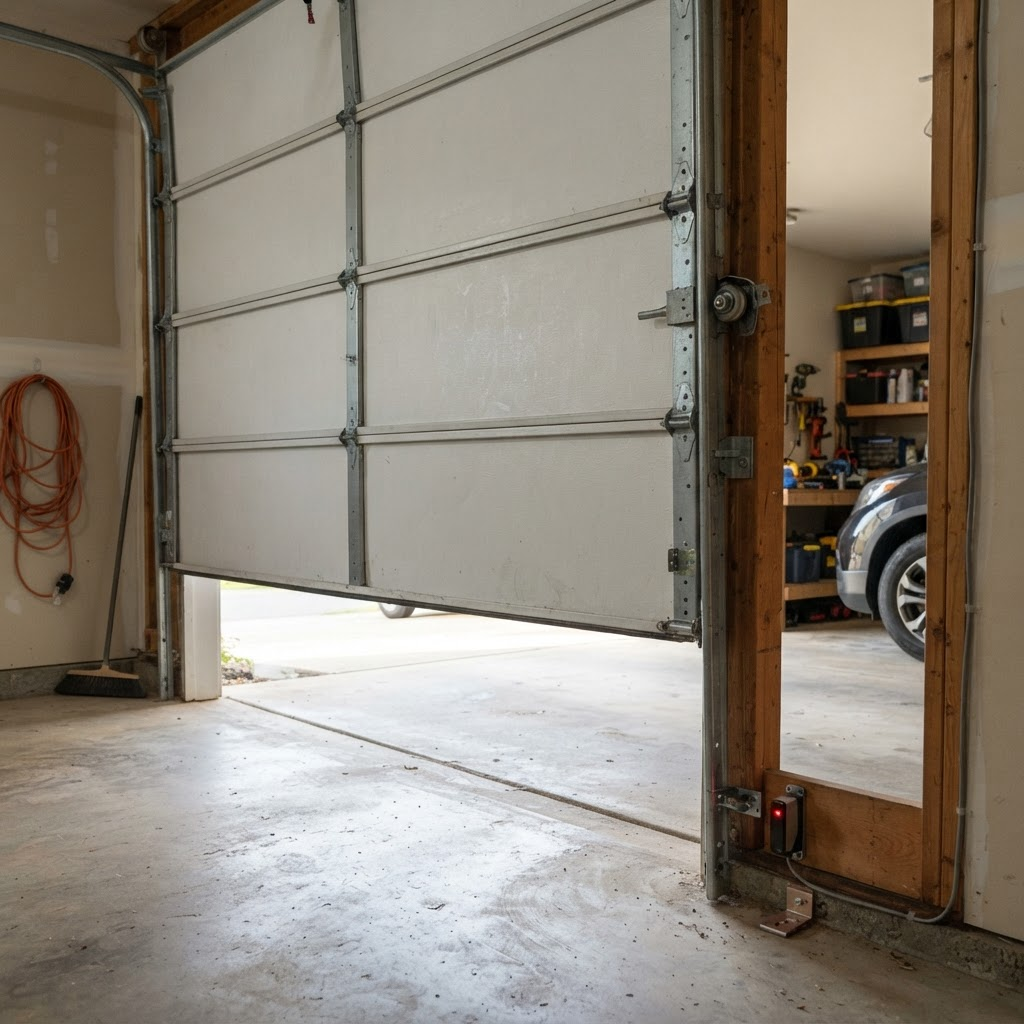
Few things are more frustrating than a garage door that won't stay closed. You press the button, the door starts descending, and then — halfway down, or three-quarters of the way, or just before it touches the floor — it reverses direction and goes right back up. You try again. Same result. The door seems to have a mind of its own, and no matter how many times you press that button, it refuses to complete the closing cycle.
This is one of the most common garage door complaints we hear from homeowners across San Jose and Silicon Valley, and while the symptom is always the same — the door reverses when closing — the causes are surprisingly varied. Understanding which cause is producing your specific reversal pattern is the key to fixing it, and in many cases, the fix is something you can handle yourself.
Cause 1 — Safety Sensor Misalignment or Obstruction
This is the most common cause by far, accounting for the majority of reversal complaints. If your door reverses immediately after starting to close, or reverses within the first foot or two of travel, and the opener light blinks several times after the reversal, your safety sensors are almost certainly the issue.
The sensors need a clear, unobstructed line of sight between the sending unit and the receiving unit. Anything that breaks or weakens that infrared beam — dust on the lens, a cobweb across the opening, a shifted bracket, direct sunlight overwhelming the receiver, or damaged wiring — will trigger the reversal.
Our complete safety sensor troubleshooting guide walks through every sensor fix in detail, from lens cleaning to realignment to wiring repair. Start there if your opener light is blinking after the reversal.
Cause 2 — Close-Limit Switch Needs Adjustment
If the door travels almost all the way down — within a few inches of the floor — and then reverses, the close-limit switch is likely set incorrectly. The close-limit switch tells the opener where the door's fully closed position is. If it's set too far, the opener thinks the door has hit an obstruction because it has traveled past its expected stopping point, and it reverses as a safety precaution.
On most modern openers, the close-limit is adjusted using a small dial or screw on the side or back of the opener motor unit, typically labeled "Down" or "Close." Turning the adjustment in small increments — usually a quarter turn at a time — increases the distance the door travels before the motor stops. Consult your opener's manual for the specific location and direction of adjustment for your model.
After each adjustment, test the door through a full close cycle. The goal is to have the door touch the floor with the bottom seal slightly compressed, then stop. If the door reverses before reaching the floor, increase the down travel slightly. If the door presses too hard against the floor and the opener motor strains, decrease it.
Cause 3 — Close-Force Setting Too Low
Related to but distinct from the limit switch, the close-force setting controls how much force the opener's motor applies during the closing cycle. If this setting is too low, the motor gives up too easily — any minor resistance from friction in the tracks, stiff rollers, or a slightly out-of-balance door will cause the opener to interpret normal operating resistance as an obstruction, triggering a reversal.
The close-force adjustment is typically a separate dial or screw from the limit adjustment, usually labeled "Force" or "Down Force." Increase it in small increments and test after each adjustment. The door should close smoothly under its own weight with the motor providing just enough force to overcome track friction. If the motor is working too hard — which you can hear as straining or grinding — the issue isn't the force setting; it's an underlying mechanical problem like a spring imbalance or track misalignment that needs to be addressed first.
There's an important safety consideration here. Don't simply crank the force setting to maximum to override a reversal problem. The auto-reverse feature exists to protect people and property. If the door reverses because it's genuinely encountering resistance — from a binding track, a failing spring, or a physical obstruction — increasing the force doesn't fix the root cause; it just forces the door through a problem that should be diagnosed and repaired.
Cause 4 — Track or Roller Issues Creating Resistance
If the door reverses at a consistent point in its travel — always at the same height — there may be a physical obstruction or restriction at that specific point in the track.
Inspect the tracks on both sides at the height where the reversal occurs. Look for a bend, a dent, debris lodged in the channel, or a roller that's binding at that point. A bent track creates a pinch point where the roller meets significantly more resistance, which the opener interprets as an obstruction.
Also check the rollers themselves. A roller with a damaged bearing, a flat spot, or a broken wheel will create intermittent resistance as it rotates. Since the defective point on the roller comes around in a cycle, it can cause reversals that seem random but are actually tied to the roller's rotational position.
Track and roller issues are best addressed by a professional who can straighten the track with proper tools and replace worn rollers with new ones. Our guide on garage door opener troubleshooting covers how mechanical resistance in the door system affects opener performance.
Cause 5 — Broken or Weakening Springs
A door with failing springs is heavier than it should be. As the springs lose tension, the door's effective weight increases from the opener's perspective, and at some point, the motor encounters more resistance than the force setting allows. The result is a reversal — the opener is protecting its gears from being stripped by a door that's become too heavy for it to handle.
If the door reverses and also feels noticeably heavy when you test it manually with the opener disconnected, spring weakness is the likely root cause. The opener isn't malfunctioning — it's responding correctly to abnormal resistance. The fix isn't adjusting the opener; it's replacing or adjusting the springs so the door is properly counterbalanced again.
This cause is particularly important to diagnose correctly because increasing the opener's force setting to compensate for weak springs puts excessive stress on the gears, motor, and drive system — leading to premature opener failure on top of the spring problem.
Cause 6 — Weather-Related Expansion
In Silicon Valley's climate, temperature swings are modest compared to extreme regions, but they're still enough to affect garage door operation in specific circumstances. On particularly hot days, steel tracks can expand slightly, and the thermal expansion of the track metal can create tight spots where the track didn't have them at cooler temperatures. Similarly, wood doors can swell with moisture changes, increasing friction in the track channel.
If reversals appear only during the hottest part of the day or during specific weather conditions, thermal effects may be contributing. This is typically a secondary factor rather than a primary cause, but it can push a system that's already borderline — slightly misaligned tracks, slightly worn rollers — over the threshold where the opener triggers a reversal.
Diagnosing Your Specific Reversal Pattern
The pattern of your reversal tells you which cause to investigate first.
- Reverses immediately when you press close, door barely moves: sensors are blocked, misaligned, or have failed wiring.
- Reverses within the first few inches of travel with opener light blinking: sensor issue confirmed.
- Reverses at a specific, consistent height every time: track obstruction, bent track, or damaged roller at that point.
- Reverses near the bottom, within inches of the floor: close-limit switch set too short.
- Reverses at varying heights, no consistent pattern: close-force set too low, or springs weakening.
- Door seems to reverse with excessive motor straining: springs failing, door out of balance, or major mechanical issue.
When to Call a Professional
Most sensor-related and limit-switch-related reversals can be resolved by the homeowner following the steps in this guide and the linked sensor troubleshooting article. However, you should call for professional garage door repair if the reversal is accompanied by unusual noises or the door feeling heavy, if you've adjusted the limits and force settings without improvement, if the door reverses differently each time with no clear pattern, or if any part of the door system — tracks, rollers, springs, cables — shows visible damage or wear.
For homeowners across Willow Glen, Cambrian Park, Berryessa, and every Silicon Valley community, a door that consistently reverses isn't just annoying — it's a security risk. An open garage door is an invitation for theft, pests, and weather damage. Getting the reversal resolved promptly protects your home and your peace of mind.
Can't stop the reversal? We fix limit switches and sensors same-day
If you've worked through these causes and your door still won't stay closed, we'll diagnose the exact reason and fix it — often the same day. From sensor realignment to limit and force adjustments to spring repair, we handle every cause on this list.
Get same-day repair