
How to Choose a Garage Door Repair Company in San Jose (Red Flags & Green Flags)
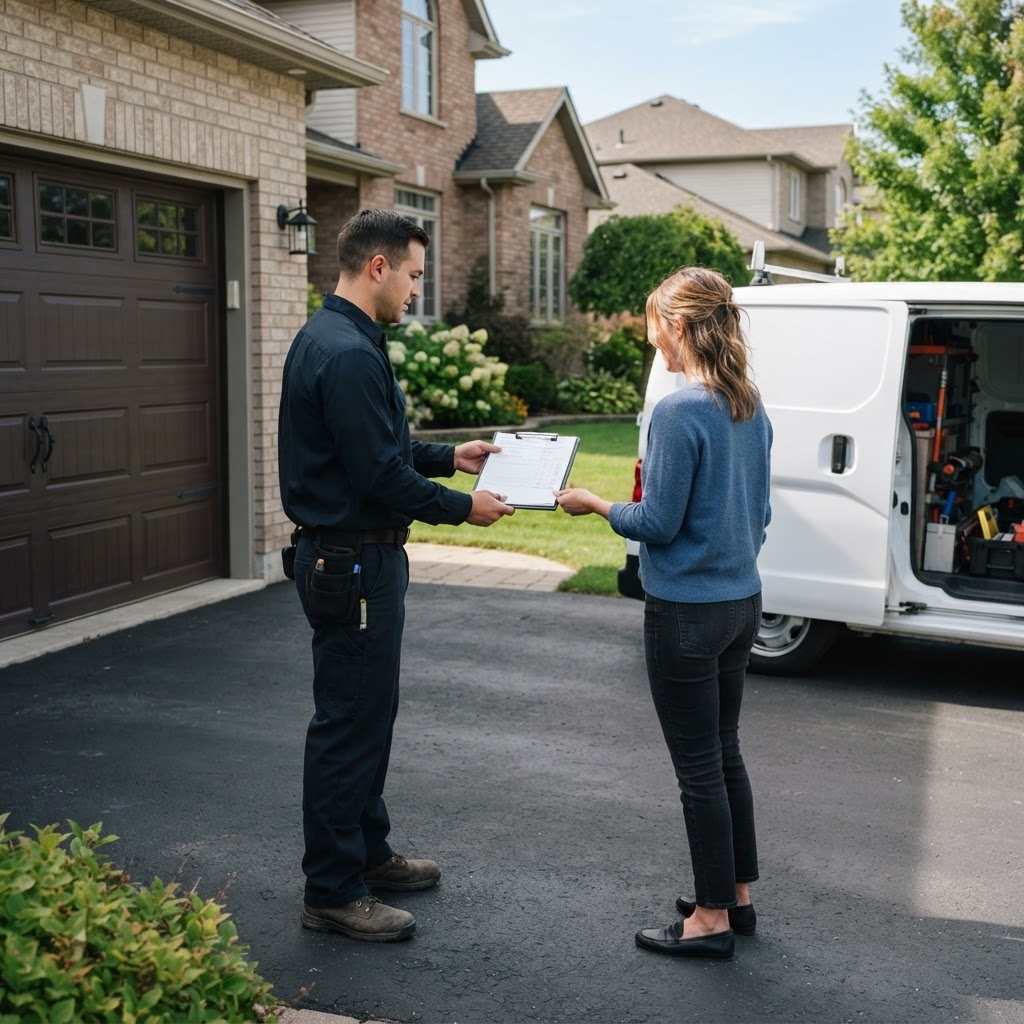
You need your garage door fixed, and you need it done right — by someone who's honest about what's wrong, transparent about what it costs, and skilled enough to fix it properly the first time. But a quick Google search returns dozens of companies, all claiming to be the best, all promising the lowest prices, all featuring walls of five-star reviews. Some look legitimate. Some look slick. And a few are designed specifically to exploit homeowners who are in a hurry, don't know what repairs should cost, and can't tell a licensed contractor from a guy with a van and a YouTube education.
This guide is written by people inside this industry who see the full spectrum — the honest companies and the predatory ones — every day. We're going to tell you exactly what to look for, what to run from, and how to evaluate a garage door repair company before you let anyone touch your door.
Green Flag #1 — A Valid California Contractor's License
This is non-negotiable and should be the first thing you verify about any garage door company you consider hiring.
In California, any contractor performing work valued at $500 or more is required by law to hold a valid license issued by the California Contractors State License Board (CSLB). For garage door work, the relevant license classification is C-61/D-28 — Door, Gate, and Activating Device Contractor.
You can verify any company's license status in seconds on the CSLB website. Enter the company name or license number and confirm three things: the license is active (not expired, suspended, or revoked), the classification covers garage door work (C-61/D-28), and there are no unresolved complaints or disciplinary actions against the license.
An unlicensed contractor may charge less upfront, but you have no recourse if the work is substandard, no worker's compensation coverage if someone is injured on your property, and no assurance that the work meets code. In San Jose and across Silicon Valley — where home values are among the highest in the country and local building codes are strictly enforced — using a licensed contractor protects both your property and your investment.
Green Flag #2 — Proof of Insurance (Both Types)
A reputable garage door company carries two distinct types of insurance, and you should confirm both before authorizing any work.
General liability insurance protects you — the homeowner — if the technician accidentally damages your property during the repair. A dropped panel that dents the garage floor, a tool that scratches your car, a mishandled spring that damages the door frame — these things happen even with skilled technicians, and liability insurance covers the cost of making it right. Without liability coverage, you'd have to pursue the damage claim directly against the company, often in small claims court.
Worker's compensation insurance protects both you and the technician. Garage door repair involves heavy components, high-tension springs, and work on ladders. If a technician is injured on your property, worker's comp covers their medical expenses and lost wages. Without worker's comp, you as the property owner could potentially be held liable for their injuries under California premises liability law.
Ask any company you're considering to provide certificates of insurance for both coverages. A reputable company will produce these immediately — they're accustomed to the request from both residential and commercial customers.
Red Flag #1 — The $19 Service Call (Bait-and-Switch Pricing)
This is the most common predatory tactic in the garage door industry, and it's so widespread that the FTC has specifically warned consumers about it in the context of home repair services.
Here's how it works: a company advertises an extremely low service call fee — $19, $29, or even “free” — to get a technician inside your garage. Once there, the technician diagnoses the problem (which is often accurately identified) and then quotes a repair price that's dramatically inflated above market rate. A spring replacement that should cost $300 to $500 is quoted at $800 to $1,200. The homeowner, already committed to the visit and feeling the urgency of the broken door, agrees to the inflated price because they don't know what the repair should actually cost.
The low service fee isn't a discount — it's bait. The company makes its margin on the inflated repair price, not the service call.
Our 2026 repair cost guide provides detailed, market-rate pricing for every common garage door repair in the Willow Glen and greater San Jose area. Review it before you call anyone, so you have a baseline for evaluating any quote you receive.
Red Flag #2 — No Price Discussion Before Dispatching
A related concern is a company that absolutely refuses to discuss pricing before sending a technician. While it's true that an exact quote requires seeing the door in person, any experienced garage door company can provide a realistic ballpark range for common repairs over the phone. If you describe a door that won't open and the company can't tell you that a spring replacement typically costs $300 to $500, that's not because the repair is uniquely complex — it's because the company doesn't want to anchor your expectations before the high-pressure in-person sales pitch.
A reputable company will give you a range. “Based on what you're describing, it sounds like a spring issue. Spring replacements in this area typically run $300 to $500 depending on the spring type and door weight. We'll confirm the exact price on-site before starting any work.” That's an honest response. “We can't discuss pricing until our technician sees the door” is evasion.
Red Flag #3 — Pressure Tactics and No Written Estimate
If a technician arrives, diagnoses the problem, and then pressures you to approve the work immediately — before you've had time to consider the price, get a second opinion, or even read the estimate carefully — that's a pressure tactic designed to prevent rational decision-making.
A legitimate repair process includes a written estimate that itemizes parts and labor, presented before any work begins, with enough time for you to read it, ask questions, and decide without feeling rushed. You have the absolute right to decline the repair, pay only the agreed-upon service call fee, and get a second opinion from another company. This is especially worth remembering during an after-hours emergency repair, when urgency makes homeowners most vulnerable to pressure.
Green Flag #3 — Transparent, Itemized Quotes
The best garage door companies provide detailed estimates that break down the cost into understandable components: which parts are needed and what each costs, how much labor is involved, whether any after-hours or emergency fees apply, and what the total will be. No ambiguous line items, no vague “repair package” pricing, no surprises at the end.
An itemized estimate lets you compare quotes from different companies on a true apples-to-apples basis. It also makes it easy to identify inflated parts pricing or excessive labor charges. Homeowners in Cupertino and Sunnyvale, where repair volume is high and competition is strong, should never accept a quote that can't be itemized.
Green Flag #4 — Consistent, Authentic Reviews
Online reviews are a valuable resource, but they require intelligent reading. Here's how to evaluate them effectively.
Look at the total review count and the average rating across multiple platforms — Google, Yelp, and the BBB. A company with 200 reviews averaging 4.6 stars with a handful of negative reviews is normal and credible. A company with 40 reviews that are all exactly 5 stars with nearly identical generic language may have purchased or solicited fake reviews.
Read the negative reviews specifically. Every company gets some negative reviews — and the nature of the complaints is more informative than the star rating. Complaints about scheduling delays, minor communication issues, or pricing that was higher than hoped (but within market range) are normal service business friction. Complaints about unauthorized work, aggressive upselling, dramatic price inflation from the quoted amount, damage during repair, or technicians who refused to leave without getting the sale — these are systemic red flags that indicate a company you should avoid.
Check whether the company responds to negative reviews, and how. A company that responds professionally, acknowledges issues, and offers to make things right is demonstrating accountability. A company that attacks reviewers, dismisses complaints, or doesn't respond at all is demonstrating the opposite.
Green Flag #5 — Local Presence and Accountability
A locally owned and operated company in Silicon Valley has a different accountability structure than a national dispatch service that routes calls to contract technicians. The local company's reputation is tied to the community. The technician who comes to your home is someone whose employer has a physical presence in the area, whose name is attached to the work, and whose continued livelihood depends on the quality of every job.
National dispatch services — identifiable by their 800 numbers, their generic websites that serve every market, and their inability to tell you the technician's name before they arrive — send contractors who may have no ongoing relationship with your area, no stake in the local reputation, and no accountability beyond the individual transaction. This distinction matters just as much in Fremont and Milpitas as it does in the heart of San Jose.
The Questions to Ask Before You Hire
When you've narrowed your choices and you're ready to call, ask these questions directly.
- Are you licensed and insured in California, and what's your CSLB license number?
- Is there a fee for the estimate, and is that fee applied to the repair if I proceed?
- Do you provide a written estimate before starting any work?
- What's your warranty on parts and labor?
- Do your technicians carry common parts on their trucks, or will they need to order parts after the first visit?
- Are you a locally owned company, or do calls route to a central dispatch?
The answers — and the willingness to answer — tell you everything you need to know about whether you're dealing with a company that earns your trust or one that's counting on your urgency to prevent you from asking.
Our Approach
We believe the best way to earn your business is to deserve it. Licensed, insured, locally operated, transparent pricing, written estimates before any work begins, and a warranty that we stand behind because our reputation in this community depends on it.
We check every box — licensed, insured, transparent pricing
If your last emergency repair experience left you feeling taken advantage of, or if you simply want a garage door repair company you can trust for years to come, we're here for homeowners across Willow Glen, Cupertino, Fremont, Milpitas, Sunnyvale, and every community in Silicon Valley.
Get an honest, itemized quote