
Insulated vs. Non-Insulated Garage Doors: Does Insulation Really Matter in Silicon Valley?
You're shopping for a new garage door, and the salesperson — or the product listing — keeps mentioning insulation. R-value this, polyurethane that, triple-layer construction, thermal efficiency. It all sounds impressive, but you live in San Jose, where it barely freezes, where summer heat is dry and manageable, and where “extreme weather” means three days of rain in a row. Does insulation actually matter here, or is it an expensive upgrade designed for Minnesota that's being marketed to you in California?
It's a fair question, and the honest answer is more nuanced — and more compelling — than you might expect. Because in Silicon Valley's mild climate, the value of an insulated garage door isn't primarily about energy savings. It's about noise, strength, comfort, and how you actually use your garage.
What Insulation Does — The R-Value Basics
Insulation's effectiveness is measured by its R-value — a number that indicates the material's resistance to heat transfer. Higher R-values mean the material does a better job of slowing heat from moving through it. The U.S. Department of Energy publishes comprehensive guidance on R-values for different building applications.
Non-insulated garage doors — typically single-layer steel — have an R-value of approximately 0 to 2. They offer virtually no thermal resistance. The temperature inside your garage will closely track the temperature outside — hot when it's hot, cold when it's cold.
Polystyrene-insulated doors (double-layer construction with rigid foam boards between the exterior steel skin and an interior backing) achieve R-values of 6 to 9. This provides meaningful improvement over uninsulated doors and is the most common mid-range option in the residential market.
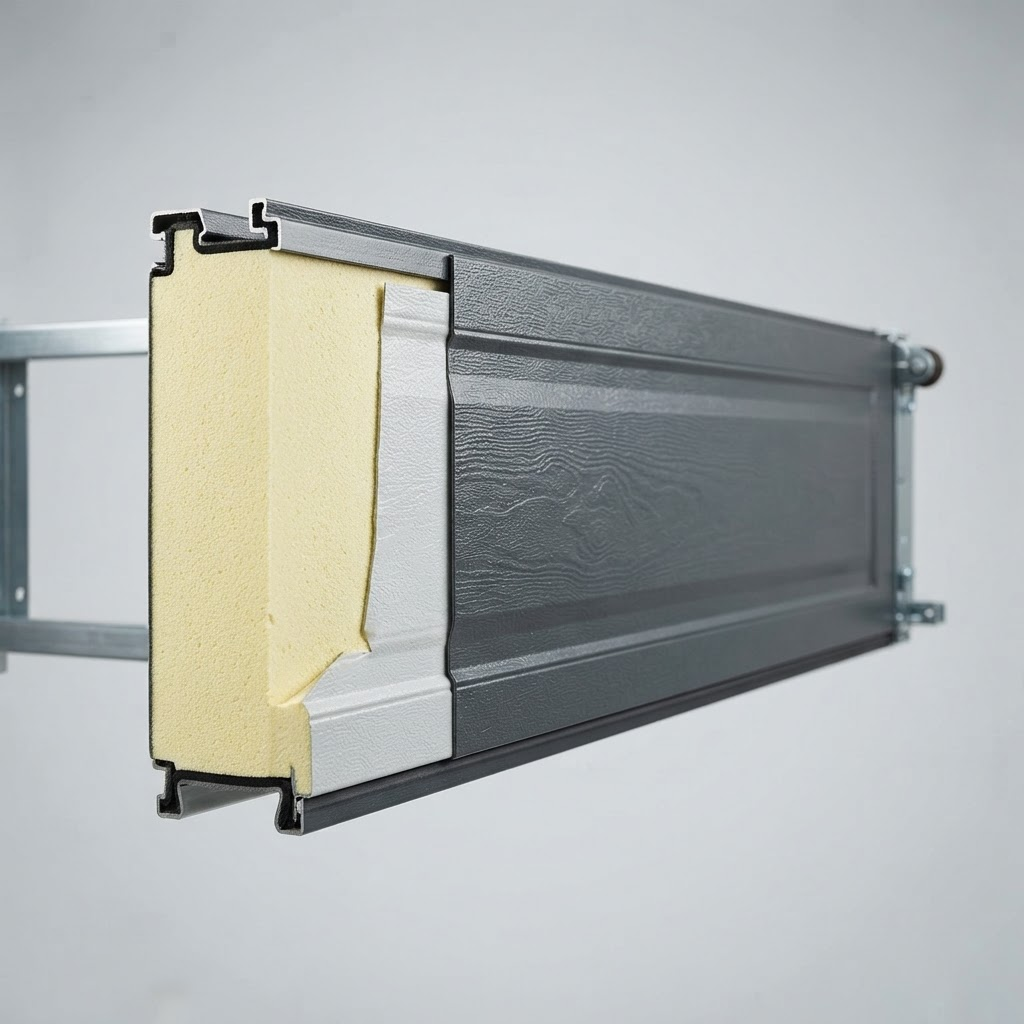
Polyurethane-insulated doors (triple-layer construction with spray-applied foam that bonds to both the exterior and interior steel skins) achieve R-values of 12 to 18. Polyurethane expands during application to fill every cavity, gap, and crevice in the panel, creating a continuous insulation layer with no thermal bridges. This is the premium option and provides the best performance across every metric — thermal, acoustic, and structural. The result is a genuine composite material whose bonded layers are stronger together than any single layer alone.
The Energy Argument — Modest but Real
In a climate with extreme winters or extreme summers — places where the temperature outside the garage regularly hits 0°F or 110°F — an insulated garage door can significantly reduce energy costs by preventing massive heat transfer between the garage and the adjacent conditioned living space. In Silicon Valley, where outdoor temperatures typically range from 40°F to 90°F, the energy savings from an insulated door are more modest. You won't see a dramatic drop in your utility bill from upgrading to an insulated door alone.
But “modest” isn't “zero.” If your garage shares one or more walls with conditioned living space — which describes the majority of attached garages in Cupertino, Sunnyvale, Mountain View, and throughout the region — an insulated door reduces the thermal load on the shared wall, which means your HVAC system works slightly less hard to maintain the indoor temperature in adjacent rooms. If you have HVAC ducts running through the garage (a common configuration in many Silicon Valley homes), an insulated door helps keep the air in those ducts closer to the conditioned temperature.
The energy argument alone doesn't justify the upgrade in our climate. But when combined with the other benefits, it's a meaningful addition to the case.
The Noise Argument — This Is Where Insulation Shines
This is the benefit that surprises homeowners most, and it's the one that matters most in daily life.
Insulation adds mass and density to the door panels. Dense panels absorb vibration rather than transmitting it. The result is a garage door that is dramatically quieter during operation — both in terms of the sound the door itself makes as it travels and in terms of how much operational noise transfers through the structure of the home.
A triple-layer polyurethane-insulated door operating on sealed nylon rollers produces a fraction of the noise that a single-layer uninsulated door produces on standard steel rollers. The difference is immediately obvious the first time you open and close the new door. For homeowners in Willow Glen, Campbell, Almaden Valley, and every neighborhood where bedrooms sit directly above or adjacent to the garage — a layout that's extremely common in Silicon Valley's attached-garage housing stock — the noise reduction is transformative.
Early morning departures no longer wake the household. Late night arrivals no longer announce themselves through the ceiling. The garage door becomes a part of the home's background rather than a periodic disruption. Our guide on diagnosing and reducing garage door noise covers the full spectrum of noise sources, and insulation is consistently one of the most impactful solutions.
The Structural Argument — Stronger Panels, More Dent Resistance
In a polyurethane-insulated door, the foam bonds chemically to both the exterior and interior steel skins during application, creating a composite material that's significantly stronger than either steel layer alone. The foam core distributes impact forces across a larger area, preventing the localized flexing that causes dents in single-layer panels.
The practical difference is substantial. A basketball that would leave a noticeable dent in a single-layer steel door bounces off a triple-layer door without a mark. A minor vehicle bump that would crease a single-layer panel is absorbed by the composite structure of a triple-layer panel. Tools leaning against the door, kids on bikes, and the everyday impacts of garage life cause far less damage on an insulated door than on an uninsulated one.
This structural benefit also extends to wind resistance. An insulated door's composite construction resists bowing and deflection under wind pressure more effectively than a single-layer door. While Silicon Valley doesn't experience hurricanes, high winds do occur during winter storms — particularly in Fremont and Newark near the bay where wind exposure is greater — and a structurally robust door handles these conditions with a wider safety margin.
The Comfort Argument — For Garages That Are More Than Garages
Silicon Valley's real estate prices make every square foot of living space valuable. It's no surprise that many homeowners use their garages for far more than parking — home gyms, workshops, art studios, music practice rooms, home offices, and project spaces are all common garage conversions in this region.
For these multi-use garages, interior temperature matters. An insulated garage door can maintain a temperature 10 to 20 degrees warmer than outside in winter and 10 to 15 degrees cooler in summer. For a garage that's just storing cars, this temperature moderation is a nice-to-have. For a garage where you spend hours working out, building furniture, or running a small business, it's a significant improvement in daily comfort.
Cost Comparison — The Premium Is Smaller Than You Think
For a standard 16-foot two-car door in the San Jose market, the cost difference between insulated and non-insulated options is approximately $300 to $800, depending on the insulation type and the overall quality tier.
- A non-insulated single-layer steel door starts around $800 installed.
- A polystyrene-insulated double-layer door starts around $1,100 installed.
- A polyurethane-insulated triple-layer door starts around $1,400 to $1,800 installed.
Given that the door will serve for 20 to 25 years, the insulation premium works out to $12 to $35 per year — less than $3 per month. For the noise reduction, dent resistance, thermal comfort, and structural strength that insulation provides, that's one of the most cost-effective upgrades available on any home component.
Our Recommendation
For most homeowners in Santa Clara, Saratoga, Palo Alto, Milpitas, and throughout Silicon Valley, we recommend polyurethane-insulated triple-layer construction. The combination of quiet operation, superior dent resistance, thermal comfort, and structural strength makes it the best overall value for the life of the door — even in our mild climate.
Our steel vs. wood vs. aluminum material guide covers how insulation options vary across different door materials and can help you make both the material and insulation decisions together.
Upgrade to insulated — quieter, stronger, more energy efficient
Thinking about a new door or a repair? We'll walk you through insulation options and give you honest pricing for your home — serving Evergreen, Berryessa, Los Gatos, and every community across Silicon Valley.
Request your free consultation