
Garage Door Panel Dented or Cracked? When to Repair a Section vs. Replace the Whole Door
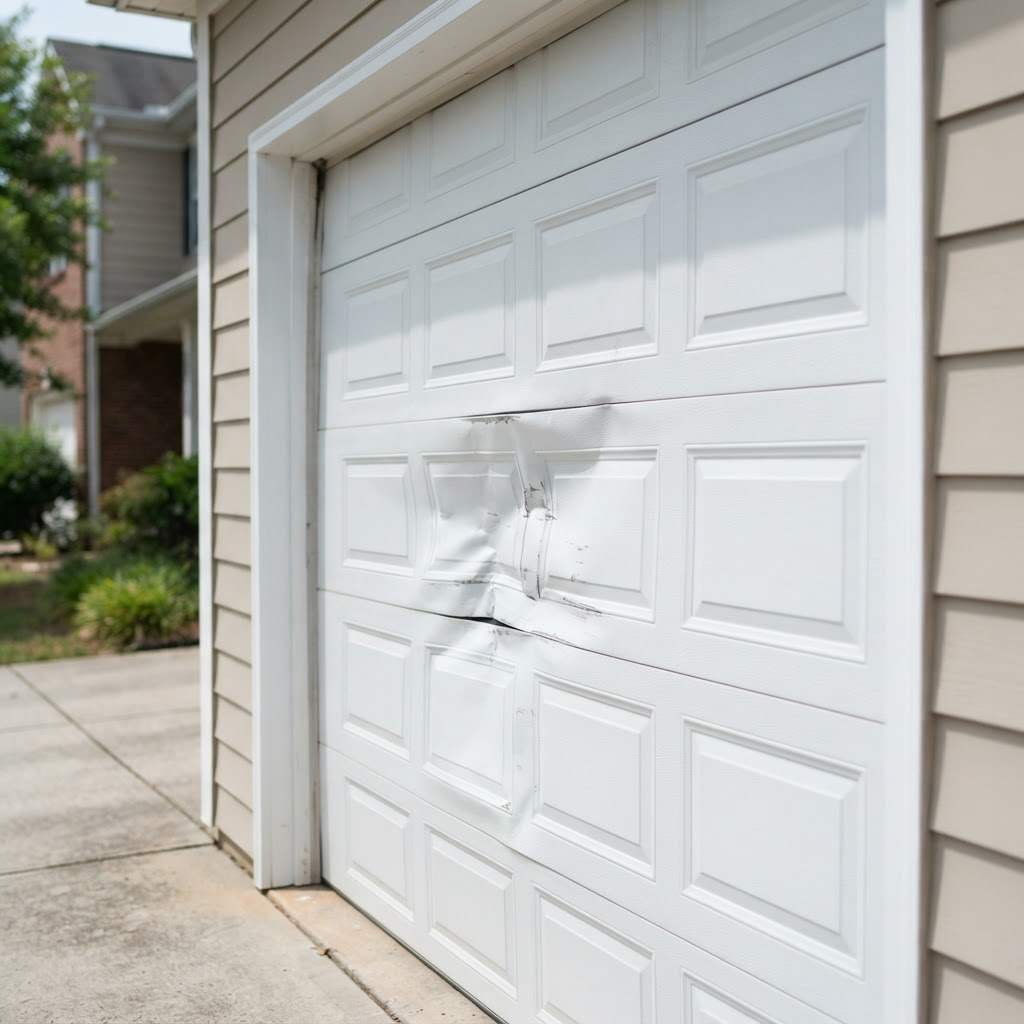
You backed into the garage door. Or your teenager did. Or a delivery truck brushed it. Or maybe nobody hit it at all — a panel just cracked along a crease line from years of flexing, temperature cycling, and gradual material fatigue. However it happened, you're now looking at a garage door with a damaged panel, and you have one immediate question: how much is this going to cost, and is there a way to fix just the damaged section without replacing the entire door?
The answer depends on several factors that aren't immediately obvious — the severity of the damage, the age and model of the door, whether replacement panels are still manufactured for your specific door, and the overall condition of the rest of the door. This guide walks through the decision framework so you can evaluate your options before calling anyone.
Option 1 — Single-Panel Replacement
Most residential garage doors are built from individual horizontal panels — typically four to five panels stacked and connected by hinges. These panels are designed to be individually removable and replaceable, which means that in many cases, a damaged panel can be swapped out without disturbing the rest of the door.
Single-panel replacement is the most cost-effective repair when it's feasible. The technician removes the damaged panel by disconnecting the hinges and rollers at the top and bottom of that section, slides the panel out, installs the replacement panel, and reattaches the hardware. The result is a door that looks and functions exactly as it did before the damage — one new panel integrated seamlessly with the existing ones.
The cost for a single-panel replacement in the Silicon Valley market typically ranges from $250 to $750, depending on the panel material, insulation level, size, and whether the panel is a standard production item or a special order. For a standard insulated steel panel on a common door model, expect $300 to $500 including the panel and labor.
Compare that to a full door replacement at $1,500 to $3,500 or more, and the economics of single-panel replacement are obvious — when it's an option.
When Single-Panel Replacement Works
Panel replacement is the right solution when the damage is confined to one panel and all other panels are in good condition, when the door manufacturer still produces replacement panels for your specific door model, and when the replacement panel matches the existing panels in style, color, texture, and insulation level.
This matching requirement is the critical factor. Garage door manufacturers produce specific panel designs — each with unique dimensions, profile shapes, embossing patterns, and colors. A replacement panel must match the existing panels exactly, or the mismatch will be visually obvious and structurally incompatible.
For doors that are less than 10 to 15 years old and made by major manufacturers — Clopay, Amarr, Wayne Dalton, C.H.I., and others — replacement panels are generally available through authorized dealer networks. For older doors, discontinued models, or doors from manufacturers that have gone out of business, finding an exact-match panel becomes significantly more difficult and sometimes impossible.
When Single-Panel Replacement Doesn't Work
There are several situations where panel replacement is either not feasible or not the best financial decision.
When the panel is no longer manufactured. If your door is 20 years old and the manufacturer has discontinued the panel profile, no exact replacement exists. Aftermarket or universal panels won't match the existing panels' profile, texture, or color — and a mismatched panel on a door that's otherwise uniform looks worse than the original damage.
When multiple panels are damaged. If two or more panels need replacement, the cumulative cost approaches or exceeds the cost of a new door — and a new door gives you entirely new panels, new hardware, new weather seals, updated insulation, and a fresh factory finish. The math shifts decisively toward full replacement once you're replacing more than one panel.
When the structural framework is compromised. If the impact that damaged the panel also bent the track, twisted the end stiles (the vertical framing at the edges of the panel), or shifted the door's alignment, replacing just the panel doesn't address the structural issues. A door that's been hit hard enough to bend its framework needs more comprehensive repair or replacement.
When the rest of the door is aging. If the damaged panel is part of a door where all the panels are showing signs of age — faded finish, surface rust, deteriorating seals, weathered appearance — replacing one panel will make that panel look conspicuously newer than its neighbors. You'll have one bright, clean panel surrounded by faded, weathered panels, which draws attention to the age of the door rather than making the damage disappear.
Assessing the Damage — What to Look For
Before calling for service, examine the damage to give yourself (and the technician) a head start on the assessment.
Minor dents — shallow depressions with no sharp creases, no paint damage, and no structural deformation — are sometimes repairable without panel replacement. A skilled technician can sometimes work minor dents out from the interior side of the panel using hand tools and controlled pressure. Success depends on the panel material, the insulation type, the dent location, and how sharply the dent creased.
Moderate dents — deeper depressions with visible creases, paint damage, or deformation that's visible at normal viewing distance — generally require panel replacement. The creased steel can't be restored to its original profile, and the paint damage leaves bare metal exposed to moisture and oxidation.
Cracks — visible fractures in the panel material, whether from impact, fatigue, or freeze-thaw cycling — always require panel replacement. A cracked panel is structurally compromised, allows air and water infiltration, and will worsen over time as the door continues to flex during operation.
Holes — punctures through the panel — obviously require replacement. A hole in a garage door panel is a security vulnerability, a weather infiltration point, and a visible eyesore that no patch will permanently solve.
The Decision Framework — Repair vs. Replace
When deciding between single-panel replacement and full door replacement, consider these factors as a connected system, not in isolation.
If the door is less than 10 years old, the damage is limited to one panel, and a matching replacement panel is available — single-panel replacement is the clear winner. You restore the door to original condition at a fraction of the new-door cost.
If the door is 15 to 20 years old, the damaged panel is part of a door that's visibly aging, and you've been thinking about upgrading anyway — full replacement is the smarter investment. Rather than spending $400 on a panel for an aging door, spend $1,800 to $2,500 on a new insulated door that gives you 20 more years of performance, improved insulation, updated styling, and enhanced curb appeal. Our steel vs. wood vs. aluminum material guide helps you choose the right material for the replacement.
If the matching panel is discontinued and no exact replacement exists — full replacement becomes the only option that produces a visually coherent result. Alternatively, some homeowners choose to replace all the panels at once with a newer compatible set, though this approaches the cost of a new door and typically doesn't include the hardware upgrades that come with a complete replacement.
Our comprehensive repair or replace decision guide covers the broader decision framework that applies to the entire door system — not just panel damage but springs, opener, tracks, and overall system health.
What About Insurance?
If your panel was damaged by a vehicle impact, falling object, or weather event, your homeowner's insurance may cover the repair or replacement cost, minus your deductible. Document the damage thoroughly with photographs — wide shots showing the full door, close-ups showing the specific damage, and shots from inside the garage if the damage is visible from both sides. This documentation supports your insurance claim and gives the adjuster a clear picture of the damage scope. The Insurance Information Institute offers a helpful overview of how homeowners coverage applies to property damage claims.
The Photo Assessment — Get an Answer Fast
For panel damage specifically, a clear photograph is often enough for an experienced technician to provide an initial assessment without an in-person visit. Take a wide-angle photo of the full door from the driveway, a close-up of the damaged area, and a photo of the door's brand label (usually on the interior side, near the top or bottom). With these images, we can typically determine whether a matching replacement panel is available, provide a ballpark cost for single-panel replacement, and advise whether full replacement is the better path — before scheduling a service visit.
For homeowners across Willow Glen, Berryessa, Evergreen, Santa Clara, Sunnyvale, and throughout Silicon Valley, we'll respond with an honest assessment — repair the panel if it makes sense, replace the door if it doesn't — and we'll be transparent about the reasoning either way.
Send us a photo of the damage for a free assessment
Dented, cracked, or punctured panel? Snap a few photos — the full door, a close-up of the damage, and the brand label — and we'll tell you whether a single-panel replacement will work or whether a full replacement is the smarter call. Honest reasoning, either way.
Request your free assessment