
The Complete Guide to Garage Door Weather Sealing for Bay Area Homes
Every October, the same pattern repeats across Silicon Valley. The first real rain of the season arrives, and homeowners who haven't thought about their garage since the last rainy season discover that water is seeping under the door, pooling on the garage floor, and dampening everything within a few feet of the threshold. Tools are rusting. Cardboard boxes are wicking moisture from the concrete. There's a musty smell that wasn't there in September. And the gap along the bottom of the door that seemed harmless in the dry months is now a channel for water, wind, and whatever else wants in.
This discovery always comes with the same realization: the weatherstripping that's supposed to keep everything out has been quietly deteriorating for months or years, and what used to be a tight seal has become a series of gaps that offer no protection at all.
The good news is that garage door weather sealing is one of the most affordable and impactful maintenance investments a homeowner can make. A full seal replacement — bottom, sides, and top — typically costs $100 to $250 installed and protects your garage from moisture, pests, dust, and drafts for three to five years. The key is doing it before the rainy season begins rather than after the damage is done.
Understanding Your Door's Four Seal Points
Your garage door has four distinct weather seal points that work together to create a barrier between your garage and the outside environment. When all four are in good condition, the barrier is remarkably effective. When any one of them fails, the entire system is compromised — because water, air, and pests will always find and exploit the weakest point.
The Bottom Seal — Where Most Problems Start
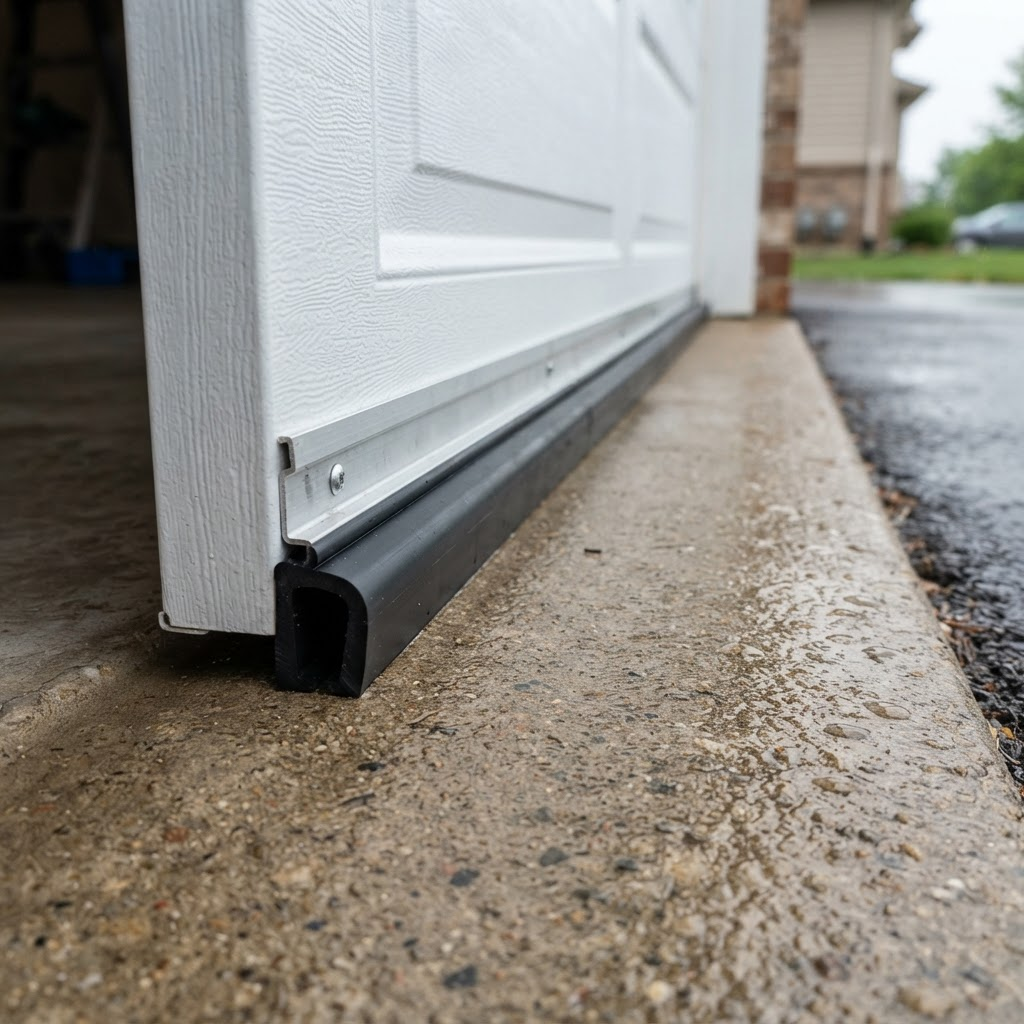
The bottom seal — also called the astragal or bottom weatherstrip — is the flexible rubber or vinyl strip attached to the bottom edge of your garage door's lowest panel. When the door closes, this seal compresses against the garage floor to create a weather-tight contact across the full width of the opening.
The bottom seal takes more abuse than any other component on your garage door. Every time the door closes, the seal is compressed against concrete. Every time it opens, the seal scrapes against the floor surface as the door lifts away. It's exposed to direct sunlight through the gap under the closed door, it absorbs rainwater pooling at the threshold, and it's subjected to temperature cycling that causes the rubber to expand and contract with the seasons.
Over time — typically three to five years of normal use — the seal hardens, cracks, tears, and loses the flexibility it needs to conform to the floor surface. A hardened seal that sits rigid against the floor instead of compressing into its contours leaves gaps at every dip, bump, and unevenness in the concrete. A torn seal creates channels where water flows directly through. A seal that has pulled partially out of its retainer channel leaves entire sections unprotected.
The signs of a failing bottom seal are unmistakable: daylight visible under the closed door (look from inside the garage on a sunny day), water or moisture tracks on the garage floor near the door's closing line, insects or debris inside the garage that clearly entered under the door, or the seal itself visibly cracked, stiff, warped, or detached.
Replacing a bottom seal is one of the simplest maintenance tasks on a garage door. Most residential doors use a T-style or retainer-style seal that slides into an aluminum channel on the bottom of the lowest panel. The old seal pulls out from one end, and the new seal slides in from the same end — no tools required beyond a tape measure, a utility knife, and perhaps a bit of dish soap as lubricant to help the new seal slide into the channel. The seal material for a standard two-car door costs $25 to $50. Professional installation — which includes measuring, cutting, fitting, and testing — typically costs $75 to $150 total in the San Jose and Silicon Valley market.
Side Seals — The Vertical Barrier
Side seals — also called jamb seals or weatherstrip — run vertically along both sides of the door frame, from the floor to the top of the opening. They create a seal between the closed door's edges and the door jamb, preventing water, wind, and pests from entering through the gaps at the sides.
Side seals are typically PVC or vinyl strips fastened to the door frame with nails or screws. The seal has a flexible fin that presses against the door's surface when the door is closed, creating a friction-based barrier. Some designs use a brush-style seal — rows of dense bristles that conform to the door surface and block air and debris while allowing the door to close without resistance.
Side seals deteriorate more slowly than bottom seals because they experience less mechanical stress. They're not compressed against concrete thousands of times per year, and they're somewhat protected from direct sunlight by the door frame. However, they do degrade from UV exposure (particularly on south and west-facing garages), temperature cycling, and physical wear from the door's edge rubbing against them during every cycle.
When side seals fail, the symptoms are localized: water streaks on the garage floor near the track areas during heavy rain, drafts felt along the sides of the closed door on windy days, and daylight visible through the side gaps. Replacement is straightforward — the old seal is pried off and the new seal is nailed or screwed into the same location. Cost for both side seals on a standard garage is typically $40 to $80 for materials and $75 to $125 for professional installation.
The Top Seal — Often Overlooked, Frequently Important
The top seal — or header seal — runs horizontally across the top of the door opening between the closed door's top edge and the header board. Its job is to prevent rain from dripping through the gap at the top of the door and landing on the inside of the door panels.
This is the most commonly neglected seal point because the gap at the top of the door is less visible than the gaps at the bottom and sides. Homeowners don't see it during normal use, and they don't feel a draft from it the way they might from a failed bottom seal. But during heavy rain — the driving, wind-angled rain that the Bay Area's atmospheric rivers deliver — water follows the exterior wall surface down to the header and flows through any gap in the top seal directly onto the inside of the door panels.
The result is rust spots forming on the inside of the top panel, water streaking down the inside of the door during storms, and moisture accumulating in the track channels and on the spring hardware above the door. Over time, this moisture accelerates corrosion on the very components that are most expensive to replace — springs, cable drums, and bearing plates. Top seal replacement costs $30 to $60 for materials and $50 to $100 for professional installation. It's often combined with bottom and side seal work during a single service visit.
Threshold Seals — The Floor-Level Complement
A threshold seal is a rubber strip that adheres directly to the garage floor along the door's closing line. When the door closes, the bottom seal compresses down onto the threshold seal, creating a double barrier — seal-against-seal rather than seal-against-concrete.
Threshold seals are particularly effective in two common situations. First, on uneven floors. Concrete garage floors are rarely perfectly flat across their full width. Settlement, cracking, root growth, and the natural imprecision of original construction create dips and high spots. A bottom seal alone can bridge minor unevenness, but on floors with more significant variation — common in older homes across Willow Glen, Almaden Valley, Cambrian Park, and other established San Jose neighborhoods — the dips exceed the seal's ability to compress far enough. A threshold seal fills those low spots from the floor side, giving the bottom seal a more uniform surface to meet.
Second, on floors where the door doesn't quite reach the concrete even with proper limit adjustment. If the floor slopes away from the door opening — a drainage design that's actually intentional in many garages — a threshold seal creates a raised lip that the door can seal against. Threshold seals cost $40 to $80 for materials and are typically installed with adhesive — a clean floor surface, a bead of construction adhesive, and weight on the seal while it cures is all that's needed. Professional installation adds $50 to $100.
The Full Sealing Package — Maximum Protection
For comprehensive weather protection, we recommend addressing all four seal points during a single service visit. A complete seal package — bottom, both sides, top, and threshold — typically costs $150 to $300 installed for a standard two-car garage door. Given that the seals provide protection for three to five years, that works out to roughly $3 to $8 per month for full perimeter sealing.
The Bay Area's rainy season runs approximately November through March, and the National Weather Service Bay Area office typically begins issuing seasonal outlooks in October. The ideal time to replace weatherstripping is September through October — before the first significant rain — so the new seals are in place and performing when the wet weather arrives.
Our quarterly maintenance checklist includes weatherstripping inspection as a standard item. Catching deterioration during a summer maintenance check gives you time to schedule a seal replacement before the fall — a proactive approach that prevents the water damage that's far more expensive to remediate after the fact.
When the Gap Isn't a Seal Problem
Sometimes a visible gap under the closed door isn't a weatherstripping issue at all — it's a mechanical issue where the door isn't traveling far enough to reach the floor. If the gap is consistent and doesn't change with new seals, the close-limit switch on the opener may need adjustment, the tracks may be restricting the door's travel, or the springs may be over-tensioned and fighting the closing motion. Our guide on fixing a door that won't close all the way covers these mechanical causes in detail.
For the technically curious, the concept of a door threshold as a sealing and transition element has been part of building design for centuries — the garage threshold seal is simply a modern adaptation of a very old idea.
Call Before the Rain
Whether you're in Los Gatos, Cupertino, Belmont, Redwood City, Mountain View, or anywhere across the Bay Area, your garage deserves to stay dry, clean, and protected. A full weather seal replacement is one of the most affordable and impactful services we offer — and it's one of those rare investments where the cost of prevention is dramatically less than the cost of the damage it prevents.
We install weather seals — keep your garage dry this winter
Get your bottom, side, top, and threshold seals inspected and replaced before the first storm. Affordable, fast, and done right — so water, pests, and drafts stay outside where they belong.
Schedule your weather seal service